Picture this. You need to plan a multi-stop RV trip to the Grand Canyon.
In your parents’ day, that meant a paper map spread across half the dashboard, some questionable roadside motels and a lot of crossed fingers. Today, you can open ChatGPT, build out your entire itinerary, compare rental companies, check campground conditions and get a full packing list without visiting a single website. By the time you are ready to book, AI has already done the selling for you.
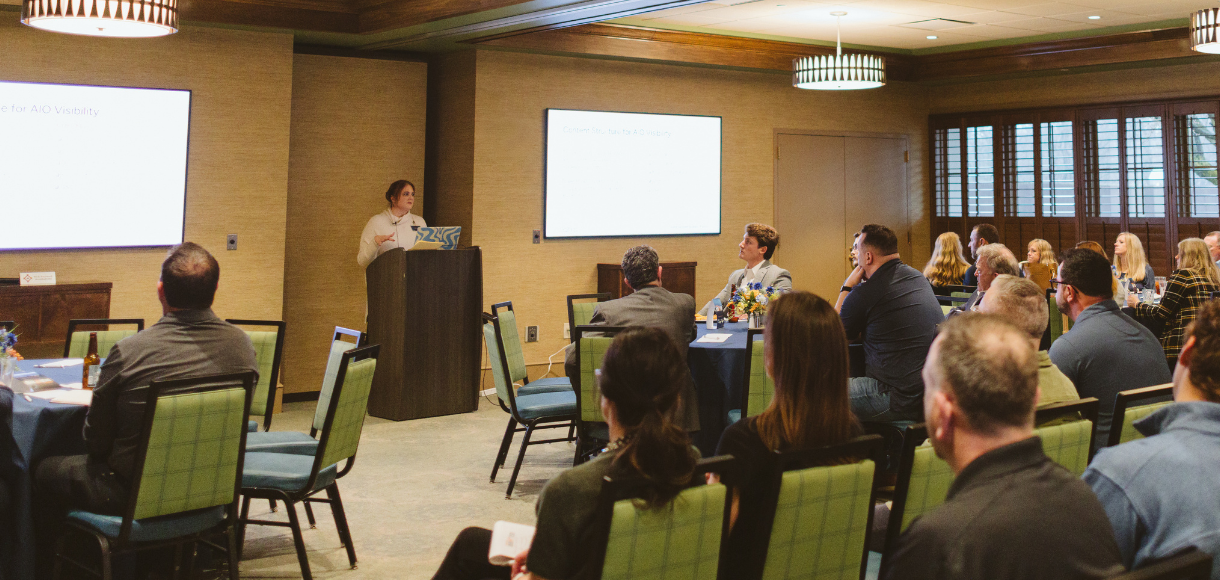
That is the shift our Director of Digital Marketing, Kaysha Hanock, brought to the Missouri Athletic Club on March 4, where a room full of St. Louis business owners and marketing professionals gathered for our latest Marketing Disrupted event. By the end of the evening, attendees walked away with a better understanding of how AI is guiding purchase decisions and what it takes to be visible in those moments.
What We Saw Coming in 2024
Two years ago, the big question in every marketing room was whether AI would kill SEO. The short answer was no, but what came next was more complicated than most people expected.
At a 2024 Marketing Disrupted event, Kaysha laid out five predictions for where search was headed: Google would hold its ground, zero-click searches would spike, content would remain the most valuable asset a brand could invest in, SEO fundamentals would still matter and schema markup would quietly become one of the most important technical moves a business could make.
By March 4, 2026, every one of those predictions had played out. And for the businesses in the room that night, that context mattered, because understanding where we have been is what makes the current shift so hard to ignore.
AI Is Having Sales Conversations Without You in the Room
The buyer journey has always depended on having the right information at the right moment. AI has made itself available for that moment around the clock.
Kaysha shared her own experience as a case study. She started on Google searching for a mattress, skipped the paid results and noticed the same brands kept showing up in every article. Wondering whether that was honest research or just marketing budgets at work, she took the question to Claude instead. What followed was a week-long conversation where Claude asked about her sleep habits, recommended a brand she had never heard of and addressed every moment of hesitation along the way. When she was finally ready to buy, Claude reminded her about a Presidents’ Day sale and she purchased at midnight from a company she discovered entirely through that conversation.
For her next purchase, a smartwatch, she skipped Google entirely and went straight to Claude. After a few questions about what she wanted, Claude mentioned that Samsung had quietly brought back a rotating bezel feature she loved on an old watch and assumed was gone for good. She bought it the same day.
Here’s what made both of those moments worth noting. When Kaysha bought the mattress, she searched Google to find the brand’s website and purchased from there. Her session showed up in their analytics as organic traffic. When she bought the smartwatch, she went directly to Samsung.com, which showed up as direct traffic. Neither was accurate because Claude referred both purchases and no analytics platform captured that. There is no assisted-by-AI column in your dashboard, and AI referral traffic, currently sitting around 1.8% of total web traffic, is almost certainly much higher than that number suggests.
How to Show Up on the New Search Floor
The good news is that the work you have already been doing still matters. The signals that help you rank on Google are largely the same ones that help AI decide who to recommend, and the goal has shifted more than it has changed.
A few things are worth moving on now. Start by claiming every directory listing you have, not just Google Business. Yelp, Apple Maps, Facebook and industry-specific directories are all places AI cross-references when forming recommendations. If your name, address or phone number is inconsistent across those listings, AI picks up on that and it works against you.
Next, ask your agency or web developer whether your site has schema markup. One study found that adding schema to a site with zero AI visibility produced measurable results in a matter of weeks with no other changes made to the site. If the answer is no or uncertain, that is worth addressing sooner rather than later.
Finally, add “How did you hear about us?” to your conversion points and include AI or AI chatbot as one of the options. It will not capture everything, but it is the closest thing available right now to tracking what your dashboard may be missing.
Are You Part of the Conversation?
Search is not dead and the fundamentals still work, but what winning looks like has changed. A few years ago it meant ranking first on Google. Now it means being the brand AI trusts enough to recommend to someone ready to make a decision.
If you want to make sure your business shows up in those moments, we are ready to help. Reach out to the 1905 New Media team and keep an eye out for our next Marketing Disrupted event.